Day 2 at NiCE World London: where AI customer experience is heading, and where it isn’t yet
Article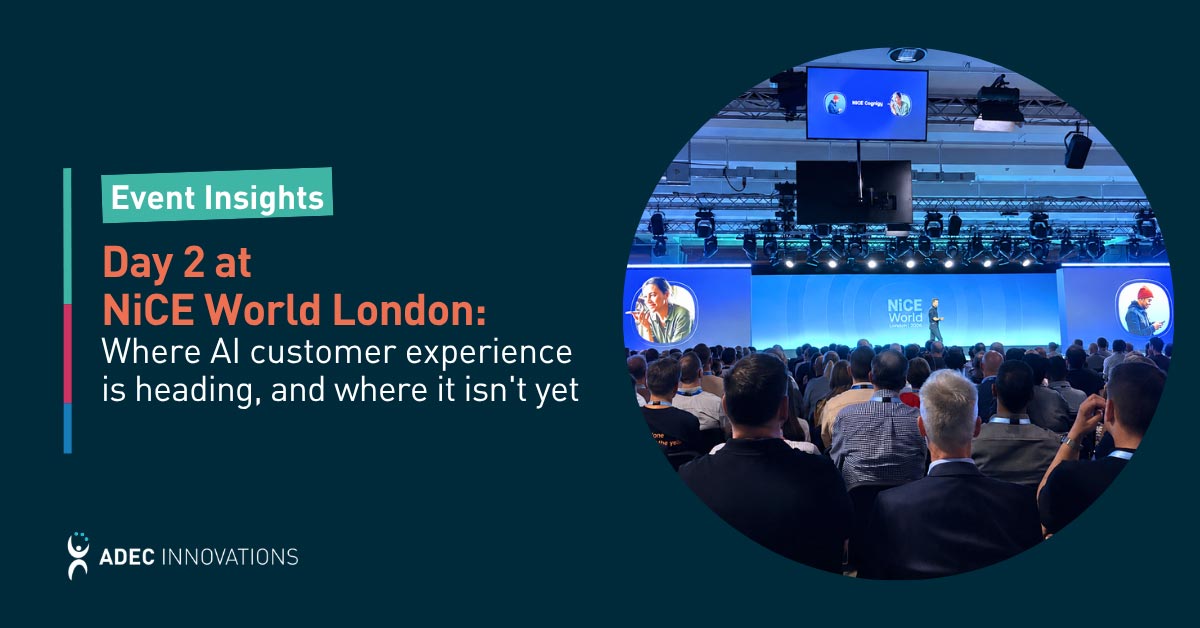
AI and customer experience are now permanently intertwined. Generative AI adoption hit 53% of the global population within three years according to Stanford HAI’s 2026 AI Index Report. That’s faster adoption rate than personal computer or the internet ever saw. Following closely behind generative AI is agentic AI with a steep adoption curve on the horizon. And both technologies are quickly shaping the present and the future of customer experience.
This AI adoption was the backdrop to Day 2 at NiCE World London, held at Kensington Olympia in July 2026. Alongside the main event, ADEC Innovations team attended the Executive Summit, an invitation-only session for 100 senior CX and operations leaders.
AI in customer experience was the clear focus across every session, but at times it was more agentic AI vision than present-day reality. Here’s what we took from those sessions: where AI-powered customer experience is heading, what still needs to evolve, and what may not change for some time yet.
The low-hanging fruit for AI in CX is gone
A point that came up several times, in the main keynotes and the Executive Summit, is that the easy wins for AI are running out.
Password resets, basic FAQ deflection, and simple booking changes, most CX organisations automated these years ago. There’s little value left in doing more of the same. One phrase captured it well: “agentifying the obvious,” automating what’s familiar rather than what’s actually valuable.
There’s also a risk in using these easy projects for building your use-case for AI-powered CX. A quick, cheap win sets the expectation that the next AI project gets delivered… well, quickly, and cheaply. Which can work against you later, when it’s time to ask for a bigger budget or a longer timeline that a loftier AI project actually needs.
The takeaway: Look for the projects that solve a real friction point, even if they need a longer timeline and a bigger budget. That means new way of thinking and a new set of questions.
Old way of thinking: “How do we deflect more calls?”
New way of thinking: “Why do customers call in the first place, and can we fix the underlying cause instead of routing around it?”
That’s a genuinely different exercise, but it can have a bigger impact on the overall experience and your ROI.
AI customer experience KPIs have to move first
The KPIs CX has inherited, such as average handle time or resolution rate, don’t show where AI is actually helping.
One speaker described how the wrong KPI focus nearly derailed their AI rollout. The AI project set out to take burdensome workload off their customer service agents. But they were still measuring outcomes the old way: call volume and speed.
When AI went live and call volume climbed instead of dropping, it felt like they were heading for failure. But when the team looked at agent and customer satisfaction, neither had dropped, in fact, both were rising. AI was handling the grunt work, which meant the interactions people were actually having were better in quality.
Openreach presented their internal case study that made a related but different point. Faced with a low Trustpilot score, they used AI-powered CX to fix the system rather than chasing a list of internal metrics.
The company embedded AI into customer engagements to move from reactive to proactively reaching out. For example, messaging people 5 days before their installation to see if the time still worked or if they’d like to reschedule. More recently they even did proactive outreach on extreme-heat days. The result, more rebookings done in advance, fewer frustrated clients trying to change something last minute and, importantly, fewer appointments cancelled.
This proactive approach helped Openreach move their Trustpilot from 2.0 to 4.7, and led to a 35% drop in missed appointments.
The takeaway:
- Agree on what you’re actually trying to fix before you agree on how you’ll measure it.
- Dig into what’s really driving your current numbers, not just what the numbers say.
- Make sure the KPIs you choose can actually capture the change you’re making, not just the activity around it.
Questioning the agent-to-agent timeline
Multiple sessions leaned into agentic AI customer experience as the next wave, evoking the almost dystopian vision of agent-to-agent communication, or A2A, as the cool kids called it, where a customer’s AI assistant talks directly with a brand’s AI assistant, no humans involved on either side.
But before brand agents start talking to our personal agents, it was clear one thing needed fixing first: the agents themselves. And more specifically, something called agent sprawl. This is what happens once a business is running a few too many AI agents, from its CRM, its CX platform, and its own team, with no shared rules for handing a customer between them.
And before you can fix that, you might want to have a look at your Frankenstack. For a few more terms worth knowing from the event, see our carousel post here.
The takeaway: A2A is not a problem most businesses need to solve in the next twelve months. Start with your agents and your stack.
For agent sprawl: map your agents, find who’s responsible for what, and understand where handoffs can happen. Fixing this properly needs something like a “control plane,” a shared governance layer for handoffs between different vendors’ agents. The idea was floated at the event, but by the industry’s own admission, it doesn’t fully exist yet.
Human-in-the-loop: where a person still has to decide
With all the AI on the table, there was still a lot of talk about humans staying in the loop, as final decision-makers, and as the ones providing empathy AI can’t quite manage yet (maybe one day).
Openreach put this into practice: automate the routine work, then reinvest that freed-up capacity into the complex queries that need real understanding.
There was also agreement that some interactions shouldn’t go to AI at all. Not because it can’t handle them, but because a customer needs someone who can actually exercise judgement, and provide real human connection.
There’s another reason a person needs to stay in the loop: liability. The Air Canada case was referenced more than once as the cautionary tale. The airline was found liable after its chatbot gave a customer inaccurate information about bereavement fares, and Air Canada’s argument that the bot was a separate entity was rejected.
The takeaway: Empathy is one reason to keep a person in the loop. Liability is the other. When AI gets it wrong, the fallout lands on the company, not the AI. It’s always worth asking yourself: what’s the one interaction you never want automated?
Where this leaves CX teams
Despite all the AI hype at NiCE World London, when one Executive Summit panel asked how many people were running generative AI in a customer-facing environment, only a handful of hands went up. Fewer still for agentic AI. There’s a gap between how much AI is talked about and how much is meaningfully implemented, and in CX, it might be bigger than most people realise.
For a closing thought, borrowed from a completely different stage: NiCE brand ambassador Kristen Bell was talking about her acting career, a refreshing change of focus from all the AI conversation, when she described it as a puzzle. You need the picture on the box, but you also just have to start placing pieces. Same goes for a real CX transformation. Know where you want customer experience to end up, then get moving, knowing some pieces might only look like they fit at first, and may need swapping out further down the line.
The work now is less about chasing AI and more about being honest with yourself. What are you actually trying to fix? Where does a person still need to hold the decision? Treat the next twelve months as picking up those pieces. And this is where a good customer experience delivery partner can help, they’ve fitted pieces like these before, and can help you get there faster.